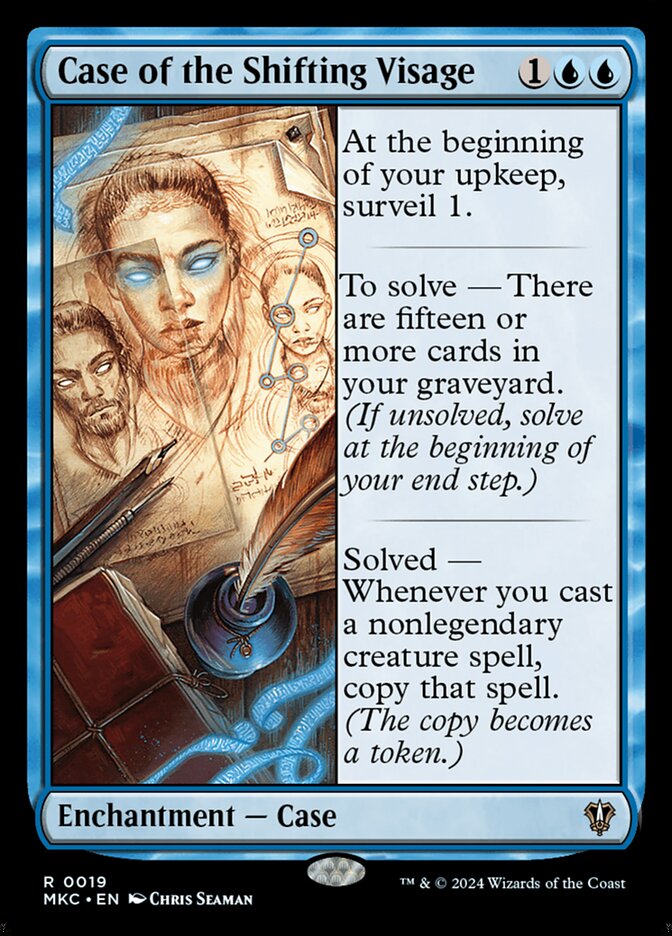
Case of the Shifting Visage
1Enchantment — Case
Text
At the beginning of your upkeep, surveil 1. To solve — There are fifteen or more cards in your graveyard. (If unsolved, solve at the beginning of your end step.) Solved — Whenever you cast a nonlegendary creature spell, copy that spell. (The copy becomes a token.)
Market prices
updated on 06/19/2026| Source | Normal | Foil |
|---|---|---|
| Cardhoarder | 0.40 tix | — |
| Card Kingdom | $0.69 | — |
| Cardmarket | €0.26 | — |
| CardTrader Buy | €0.14 | — |
| TCGplayer | $0.35 | — |
Trend · last 90 days · EUR
€0.16CardTrader market
135 offers · from €0.14 · avg €89.85 · max €10,000.64
Near Mint: 115 · Slightly Played: 19 · Moderately Played: 1
Rulings (16)
“To Solve — [condition]” means “At the beginning of your end step, if [condition] and this Case is not solved, it becomes solved.”
02/02/2024If the spell that’s copied has an X whose value was determined as it was cast, the copy has the same value of X.
02/02/2024You can’t choose to pay any additional costs for a copied spell. However, effects based on any additional costs that were paid for the original spell are copied as though those same costs were paid for the copy too.
02/02/2024If a permanent spell is copied, it’s put onto the battlefield as a token as the spell resolves rather than putting the copy of the spell onto the battlefield. The rules that apply to a permanent spell becoming a permanent apply to a copy of a spell becoming a token.
02/02/2024Each Case has two special keyword abilities: to solve and solved.
02/02/2024The token that a resolving copy of a permanent spell becomes isn’t “created” and won’t interact with abilities that care about tokens being created, such as that of Case of the Pilfered Proof.
02/02/2024“To solve” abilities will check for their condition twice: once when the ability would trigger, and once when it resolves. If the condition isn’t true at the beginning of your end step, the ability won’t trigger at all. If the condition isn’t true when the ability resolves, the Case won’t become solved.
02/02/2024“Solved — [static ability]” means “As long as this Case is solved, [static ability].” Static abilities are written as statements, such as “Creatures you control get +1/+1” or “Instant and sorcery spells you cast cost {1} less to cast.”
02/02/2024The copy is created on the stack, so it’s not “cast.” Creating the copy won’t cause abilities that trigger when a player casts a spell to trigger.
02/02/2024Being solved is not part of a permanent’s copiable values. A permanent that becomes a copy of a solved Case is not solved. A solved Case that somehow becomes a copy of a different Case stays solved.
02/02/2024The triggered ability Case of the Shifting Visage has when it’s solved and the copy it creates will resolve before the spell that caused the ability to trigger.
02/02/2024Once a Case becomes solved, it stays solved until it leaves the battlefield.
02/02/2024Cases don’t lose their other abilities when they become solved.
02/02/2024“Solved — [Triggered ability]” means “[Triggered ability]. This ability triggers only if this Case is solved.” Triggered abilities use the word “when,” “whenever,” or “at.” They’re often written as “[Trigger condition], [effect].”
02/02/2024The meaning of “solved” differs based on what type of ability follows it. “Solved — [activated ability]” means “[Activated ability]. Activate only if this Case is solved.” Activated abilities contain a colon. They’re generally written “[Cost]: [Effect].”
02/02/2024Any choices made when the spell resolves won’t have been made yet when it’s copied. Any such choices will be made separately when the copy resolves.
02/02/2024Legality by format
| Brawl | Not legal |
| Commander | Legal |
| Duel Commander | Legal |
| Legacy | Legal |
| Modern | Not legal |
| Oathbreaker | Legal |
| Old School | Not legal |
| Pauper | Not legal |
| Pioneer | Not legal |
| Premodern | Not legal |
| Standard | Not legal |
| Vintage | Legal |
| Block Constructed | Not legal |
| Extended | Not legal |
| Frontier | Not legal |
| Tiny Leaders | Not legal |